Mastopexy with augmentation combines a breast lift (to raise/tighten sagging tissue) with implants (to restore or add volume) in one operation. Mastopexy addresses ptosis with incision patterns (periareolar “donut,” vertical/lollipop, or inverted-T/anchor) chosen for the degree of sagging, while implants (saline or silicone gel) supply stable volume and upper-pole fullness.
Doing both in one operation means one anesthetic and one recovery, but it is a more complex plan than either alone, because lifting tightens the breast while an implant adds volume to it. Some surgeons prefer to stage the two for patients with significant sagging or thin tissue, so recommendations and results vary by patient and by provider. If you are weighing it against a breast lift on its own, a consultation with a certified plastic surgeon is the way to compare, and Beautifi can help you explore qualified providers and financing.


Expect about one to two weeks off desk work, with soreness, swelling and tightness heaviest in the first few days and managed with prescribed pain relief. A surgical bra is usually worn for several weeks. Light walking is encouraged early, but lifting, overhead reaching and chest exercise are typically restricted for around four to six weeks, and full clearance often takes longer than for a lift alone because two things were done at once. Sleeping on your back is usually advised for the first few weeks. Contact your surgeon promptly about fever, spreading redness, worsening pain or sudden swelling on one side.
Scars follow the incision pattern your surgeon chooses for the degree of sagging. A periareolar or donut pattern leaves a scar around the areola, a vertical or lollipop pattern adds a line from the areola to the crease, and an inverted-T or anchor pattern adds a scar along the crease as well. All are permanent. They are usually raised and pink for several months and then flatten and fade over roughly a year to eighteen months, though final appearance varies with skin type and healing. Sun protection, and any scar care your surgeon recommends, make a genuine difference to how they settle.
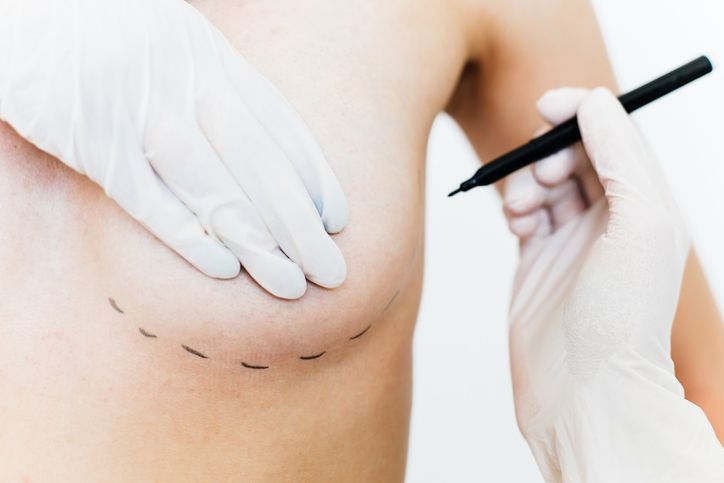
Preparation starts at consultation with an examination, measurements, a discussion of implant size and incision pattern, and often a mammogram depending on your age and history. Your surgeon may ask you to stop smoking, pause medications and supplements that increase bleeding, and arrange someone to drive you home and stay the first night. The operation is normally done under general anesthetic and takes around two to three hours or more, longer than either procedure alone. Markings are drawn while you are standing beforehand. You usually go home the same day in a surgical bra with written aftercare instructions and a follow-up booked.
Swelling hides the result at first. Most of it resolves over the first six weeks, implants settle into position over roughly three to six months, and scars keep maturing for a year or more, so the final appearance is not visible early on. The lift component is long-lasting, but gravity, weight change, pregnancy and breastfeeding all continue to affect the breast afterwards. Implants are not lifetime devices and may need revision at some point. Before and after photos from your own surgeon, of patients with similar starting anatomy, are far more useful than general images.
Look for a surgeon certified in plastic surgery by the Royal College of Physicians and Surgeons of Canada, operating in an accredited facility. Because combining a lift with implants is more demanding than either alone, ask specifically how often they perform the combined operation, how they decide between one stage and two, which incision pattern they would use for your anatomy and why, and what their revision policy covers. Ask to see before and after photos of patients with similar starting anatomy. A written quote should separate surgeon, anesthesia and facility fees, and Beautifi can help you compare qualified providers and financing options.
Your surgeon marks lift incisions (periareolar, vertical, or inverted-T) based on sagging and skin excess. After reshaping and elevating the nipple-areola complex, a saline or silicone implant is placed (often dual-plane/under muscle for coverage), then the lift is closed with layered sutures.
Adults in good health with ptosis (sagging) and deflated volume after pregnancy, weight change, or aging—who want both corrected in one recovery. Your consult reviews skin quality, nipple position, implant options, and whether single-stage or staged surgery fits best.
Possibly, but supply can be affected. Breast surgeries (including lifts and augmentations) may alter ducts/nerves that support lactation; under-muscle implant placement tends to affect supply less than over-muscle. Plan ahead and discuss technique if future breastfeeding is a priority.
Implants are not lifetime devices; some patients choose revision or replacement over time for cosmetic or medical reasons. For silicone gel implants, the FDA recommends ultrasound or MRI at 5–6 years, then every 2–3 years to screen for silent rupture (applies in Canada as a general safety guideline). Keep routine clinical follow-ups.
All surgery carries risk: bleeding/hematoma, infection, wound-healing issues, changes in nipple sensation, scarring, or dissatisfaction requiring revision. Implant-related risks include capsular contracture, rupture, need for reoperation, and rare BIA-ALCL, which is most strongly associated with textured implants; discuss surface choices and symptoms to watch for.
Public clinic references show combined pricing that varies by city, implant type, and lift complexity. Overall, many Canadian quotes fall roughly ~C$11,500–$19,000+ depending on scope. Your consultation provides an exact quote.
For some anatomies/risks, surgeons stage (lift first, implants later). Large series and reviews show one-stage can be performed safely in selected patients by experienced surgeons; your surgeon will recommend the approach with the lowest re-op risk for your case.
If you need position + volume, combining them can deliver the most balanced, lasting result in one recovery—with the caveat that implants require long-term follow-up and may need future revision.
Yes—Beautifi offers flexible monthly payments. Use the Loan Calculator to estimate payments or Apply Now to explore options (no obligation).