Dental implant surgery involves replacing a tooth’s root with metal, screw-like posts and replacing damaged or missing teeth with artificial teeth that look and function like natural teeth. Dental implant surgery offers an alternative to dentures or bridgework that don’t fit well, or when your natural teeth roots don’t allow for denture building or bridgework. In addition, dental implant surgery provides a strong foundation for permanent or removable replacement teeth that are made to match your natural teeth.
The average cost of dental implant surgery in Canada is between $900 and $6,000 (per tooth). If you need help paying for the procedure, financing dental implant surgery is easy with Beautifi. Break down the cost of your procedure with flexible monthly payments, so you can manage your budget while achieving a beautiful smile.


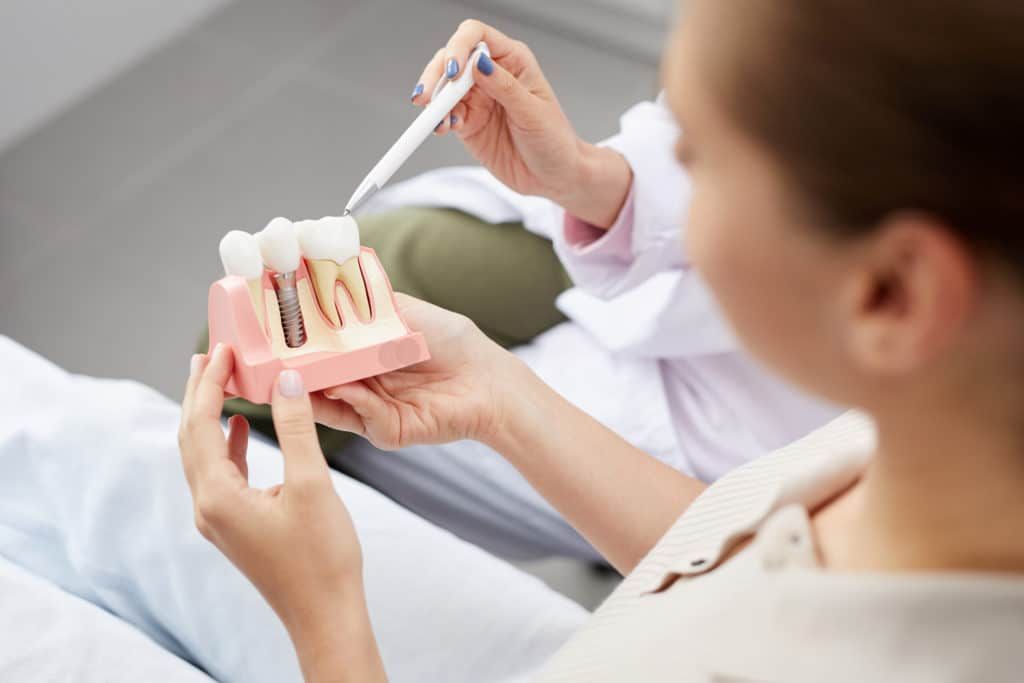


Dental implant surgery involves replacing a tooth’s root with metal, screwlike posts and replacing damaged or missing teeth with artificial teeth that look and function like natural teeth. Dental implant surgery offers an alternative to dentures or bridgework that doesn’t fit well, or natural teeth roots don’t allow building dentures or bridgework tooth replacements. In addition, dental implant surgery provides a strong foundation for permanent or removable replacement teeth that are made to match your natural teeth.
Dental implants are surgically implanted into the jawbone to replace lost dental roots. Because the titanium in the implant fuses with the jawbone, it won’t slip, create noise, or cause bone damage as fixed bridgework or dentures can. Additionally, the materials in the implant do not decay like natural teeth that support regular bridgework.
To improve speech – Poor-fitting dentures can cause the teeth to slip in the mouth, causing slurred speech or mumbling. The teeth are tightly secured with dental implants, and speech can go unaffected.
To improve overall appearance – As dental implants look and feel like natural teeth and are fused with your jawbone, they are permanent.
To assist with eating – Dentures can cause the teeth to slip, making it difficult to chew. As implants function exactly like natural teeth, chewing foods is much easier and pain-free.
To improve comfort – As dental implants are permanent, they eliminate the discomfort of removable dentures.
To improve oral health – Dental implants don’t reduce any other teeth in order to be fitted, such as a tooth-supported bridge. Because the neighbouring teeth are not altered to support the implant, more of your natural teeth are preserved, resulting in better long-term oral health. Individual implants also make it easier to clean between teeth, resulting in improved oral health.
To improve self-esteem– Dental implants give you back your smile and help improve self-esteem.
Dental implants and bridges are both used to replace missing teeth, but implants offer several distinct advantages in terms of longevity, function, and overall oral health.
Longevity is one of the most significant benefits. Dental implants fuse with the jawbone and can last a lifetime with proper care. Bridges, on the other hand, typically need replacement every 7–15 years.
Bone preservation is another key advantage. Implants stimulate the jawbone like natural teeth, helping to prevent bone loss and maintain facial structure. Bridges do not provide this stimulation, which can lead to gradual bone deterioration beneath the missing tooth.
Implants are self-supporting, meaning they do not require altering adjacent healthy teeth. Bridges rely on neighboring teeth for support, which involves shaving down those teeth to anchor the restoration—potentially weakening them over time.
In terms of appearance and feel, implants function and look like natural teeth. They are stable and comfortable, making it easier to speak and chew. Bridges can feel less natural, especially as the surrounding teeth or gums change over time.
Maintenance is also easier with implants. They can be brushed and flossed just like your natural teeth. Bridges require more complex cleaning under the artificial tooth, which can be harder to maintain and may increase the risk of decay or gum disease.
Overall, dental implants offer a more durable, bone-friendly, and low-maintenance solution, making them a preferred long-term option for many patients when suitable.
You may be a right fit for dental implant surgery if you have the following:
One or more missing teeth
Enough bone to secure implants
Healthy oral tissues
Unable to wear dentures
You don’t have any health conditions that would affect bone healing
Want to improve your speech
Willing to commit to a several month process
Don’t smoke
Step one: Dental implant surgery is an outpatient procedure. Your mouth with be numbed with a local anesthetic, or you will be given IV sedation.
Step two: When your mouth is numb or you are sedated, the oral surgeon will make an incision in your gum to expose the bone.
Step three: When the incision is made, a drill is used to create spaces in the bone for the implant screw. From there, the implant goes into place.
Step four: Your incision will be closed, and you made need stitches depending on the size of the incision.
Step five: Dental implants are a lengthy process, so you will be sent home to recover and probably return for the second phase of the procedure in a few months. This gives the bone time to grow around the implant, making it strong enough to stay in place. This process is called Osseointegration, which means the titanium from the implant combines with the bone.
Step six: You will return to the dental office, and the dentist will determine if the implant is secure enough to hold the new tooth. Then, your dentist will make another incision, re-exposing the implant and placing an abutment piece on the implant (this keeps the new tooth in place).
Step seven: When your gums heal, you will be brought back to the dental office to make an impression of your teeth, and from there, a custom replacement tooth will be created (this is called a crown). The crown is then attached to the abutment.
Depending on the dentist or oral surgeon, the implant usually takes about an hour per tooth. After the implant is placed, the next appointment will be around four to six months later but could take up to eight months.
Each patient is unique, and recovery times differ from person to person, making it difficult to anticipate how long it will take to recover. Some circumstances, however, can have an impact on the healing process. These include:
The number of teeth extracted and implanted
The placement of the implants – lower jawbone implants heal faster than upper jawbone implants
If bone grafting is required
Your general dental hygiene, as well as the health of your bone structure
The time it takes for your body to heal
Smoking and hygiene habits
After surgery, you can expect a bit of pain in the first two days. You may experience some symptoms, which could include:
Bleeding of the gums
Swelling around your cheeks, mouth, and eyes
Pain or discomfort
Your stitches should dissolve in a few days, but they could take up to two weeks to fully dissolve. After one week, the pain and inflammation should start to subside, and your mouth should begin to feel normal again.
Following dental implant surgery, your dentist will recommend that you eat soft foods for up to 30 days after receiving your implant. For more complex procedures, a soft food diet may be required for up to six weeks.
Post-op care is critical after dental implant surgery. Here are some of the top things to avoid:
Drinking with a straw, rinsing your mouth, and spitting – May cause more bleeding.
Do not poke the incision with your tongue, fingers, or any other instrument – this may loosen the stitches and re-open your incision.
Smoking
Crunchy, sticky, chewy, acidic, and spicy foods – stick to a soft food diet, e.g., smoothies, cool soups, applesauce, fruit juice, pudding, etc.
Excessive exercise
Electric toothbrushes
Alcohol
Dental implant surgery, like any other procedure, carries certain risks. Problems are usually rare, and if they do occur, they are typically minor and are easily treated. Some of the dangers of dental implant surgery include:
Infection at the implant site
Damage to surrounding teeth and blood vessels
Nerve damage – can cause pain, numbness, and tingling
Sinus problems
The price of dental implant surgery will vary from patient to patient as the complexity of the procedure is different for everyone. However, Canada’s average cost is approximately $900-$6000 per tooth.
77/88 people who have undergone dental implant surgery have rated the procedure “Worth It” (88%)
Source – Realself.com
 English English
  French